

If you want to start remote work, your first instinct might be to:
- update your résumé
- scroll job boards
- search “remote jobs no experience”
- apply to 25 listings in one night
I get it.
But remote jobs don’t go to the most motivated person. They go to the most reliable one.
And reliability isn’t personality. It’s built on skills.Before you apply anywhere, make sure you’re strong in these three areas.
1. One Monetizable Digital Skill
Remote work is not a job title. It’s a delivery method.You still need to bring value.At the core of every remote role is one simple question: What can you do that solves a problem?
That’s your monetizable digital skill.It could be:
- social media management
- copywriting
- graphic design
- email marketing
- virtual assistance
- bookkeeping
- video editing
- web design
- automation setup
- project coordination
It doesn’t have to be glamorous. It has to be useful.You don’t need five skills to start.
You need one solid skill you can improve consistently.
Many beginners try to apply everywhere without actually mastering anything. That’s why they struggle.
Specialization builds confidence.Confidence builds results.Results build credibility.
Start with one.
2. Clear Communication (Clear > Constant)
In remote work, communication replaces presence.
You don’t have office body language.You don’t have hallway clarifications.You don’t have someone tapping your shoulder.
Everything relies on how clearly you communicate through:
- Slack/Teams/Google Chat
- Zoom
- project management tools
Strong remote workers:
- give updates without being chased
- ask thoughtful questions
- summarize decisions
- clarify expectations
- communicate proactively
You don’t need to message constantly. You need to communicate clearly.Trust grows through clarity.
And in remote work, trust is currency.
3. Self-Management + Problem-Solving
When you work remotely, no one is supervising you.
No one sees when you log in.No one reminds you to focus.No one double-checks your schedule.
That’s why self-management matters.This includes:
- managing your time
- protecting your energy
- meeting deadlines consistently
- organizing your workload
- staying accountable
But self-management alone isn’t enough.Remote teams don’t just want task-doers. They want problem-solvers.
Instead of saying:“I finished the task.”
Strong remote workers say:“I noticed this issue. Here are two possible solutions.”
That shift is powerful.
AI can complete tasks. Humans who think critically stay valuable.
A monetizable skill gets you in the door.Communication builds trust.
Self-management and problem-solving keep you there.
The Truth Most People Skip
You don’t need:
- a fancy home office
- to travel full-time
- five remote jobs on your résumé
- to look productive on Instagram
You need:
- one valuable skill
- clear communication
- the discipline to manage yourself
- the initiative to solve problems
Remote companies/employers hire people who make their lives easier.
If you become low-risk and high-value, you stand out immediately.
If You’re Serious About Starting Remote Work
Don’t just apply. Prepare.
Practice writing clearly. Build small proof of work. Track results.Strengthen one skill deeply before expanding.
Remote work isn’t magic.
It’s structure + value + consistency.
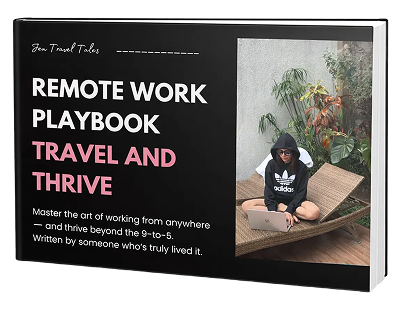
If you’re currently in a 9–5 exploring flexibility, a freelancer wanting to work from anywhere, or someone who simply dreams of a location-independent life, my ebook Remote Work Playbook: Travel & Thrive walks you through the mindset, systems, and practical steps that helped me build a sustainable work-from-anywhere life.
Because remote work doesn’t start with freedom.
It starts with foundations.And you can build them.
.png)